There is a temptation to build one big API endpoint that "does everything." For human users, a dashboard can hide that complexity. For AI agents, the opposite is true: the more a single endpoint does, the harder it is for a model to know when to call it and what it will return.
Why small tools win for agents
- Clear selection. A model reads a description and must decide if the tool fits. "Count words, characters, sentences, and paragraphs" is an easy decision. "Process your document" is not.
- Stable contracts. A tool with one job has a simple input and output schema. Errors are easier to reason about, and the model can recover from a bad call without guessing.
- Verifiable. A single-purpose module can be inspected end to end. An agent (or a human) can read the source and know exactly what it does before running it.
- Composable. Small tools chain naturally: clean text, then convert it, then measure it. Each step is a checkpoint, not a black box.
What the catalogue looks like in practice
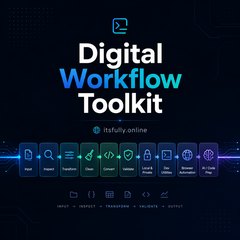
This site's manifest is 145 tools across 13 categories precisely because each tool is small. Text cleaning is several tools (Copy-Paste Cleanup, Whitespace & Line Cleanup, Remove Invisible Characters) rather than one "text doctor." JSON work is four tools rather than one "data utility."
Going deeper on this theme: How to Remain Valuable When Intelligence Becomes Cheap — the scarce human, economic, and strategic advantages that stay valuable when AI does the cognitive work. A 224-page practical book, $3.84. Read it on Gumroad →
The trade-off
The cost of small tools is catalogue size — an agent has more entries to scan. That is manageable when every entry is well described and the manifest is structured by category. The benefit is a workflow where each call is predictable, each failure is localized, and each result can be trusted without a leap of faith.