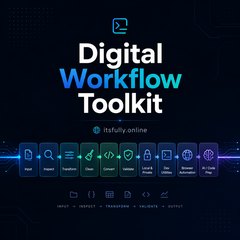
In the fast-paced digital landscape of 2026, the "quick and dirty" online file converter has become a staple of our browser tabs. We’ve all been there: you have a proprietary CAD file, a massive 4K video, or a sensitive PDF that needs a format swap, and a Google search promises a "free, instant" solution. You upload, you wait for the progress bar, and you download.
But behind that convenient interface lies a growing list of compromises that modern professionals can no longer afford to ignore. From catastrophic security warnings issued by the FBI to the emergence of superior "edge" technologies, the era of the standard cloud-upload converter is coming to a close. Here is why your go-to conversion site might be doing more harm than good.
Related reading: How to Remain Valuable When Intelligence Becomes Cheap — a 224-page practical book on staying valuable as intelligence gets cheap. $3.84. Read it on Gumroad →
The Hidden Cost of the "Cloud Upload"
The fundamental flaw of traditional online converters is the upload itself. When you send a file to a standard converter, you are physically transferring your data to a third-party server. In 2026, this "server-side" processing is increasingly viewed as an unnecessary liability.
Recent cybersecurity reports have highlighted a surge in "malicious mirrors"—sites that appear identical to popular conversion tools but are actually fronts for data harvesting. Once your file is on their server, you lose all sovereignty over it. Whether it’s an invoice containing banking details or a creative brief with intellectual property, that data can be indexed, stored, or sold long after you’ve cleared your browser history.
The Rise of Local-First Web Tools
The most significant shift in 2026 is the transition toward WebAssembly (WASM) and local browser-based processing. Modern web platforms are now capable of performing complex computations—like video transcoding or PDF flattening—directly on your machine's hardware, without your data ever leaving the browser.
Standard converters that still rely on "Upload > Process > Download" are effectively obsolete. Local-first tools leverage your device's CPU and GPU, offering three distinct advantages:
Zero-Latency Privacy: Since the file never touches a remote server, the risk of a data breach is mathematically eliminated.
Offline Capability: These tools work even when your connection drops, as the logic lives within your browser’s cache.
Bypassing File Limits: Traditional converters often cap uploads at 100MB to save on bandwidth costs. Local tools are limited only by your own RAM, allowing for the conversion of multi-gigabyte files in seconds.
The Quality and "AI-Slop" Dilemma
We’ve entered an age where many free tools use poorly optimized, "black-box" algorithms to rush conversions. This often results in what designers call "digital rot"—subtle artifacts in images, broken anchors in vector files, or corrupted metadata in audio tracks.
Standard converters often strip away the "XMP" or "EXIF" data that professionals rely on for version tracking and copyright. Furthermore, many free PDF-to-Word converters now use low-tier AI OCR (Optical Character Recognition) that hallucinates text, turning a professional contract into a minefield of typos. High-performance alternatives prioritize "lossless" transitions, ensuring that a format change doesn't mean a quality downgrade.
Moving Toward a Smarter Workflow
If you are still using a converter that asks you to "Select File" and wait for an upload, you are likely using a tool built for 2016, not 2026. The future of digital utility lies in client-side applications—sophisticated web tools that treat your browser as a powerful, private workstation.
At 'itsfully.online', we advocate for tools that respect both your time and your telemetry. By choosing local-processing utilities, you aren't just getting a faster file; you're adopting a security-first mindset that protects your professional integrity.