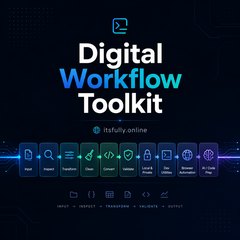
The era of heavy desktop installations is giving way to a leaner, more modular digital environment. For developers, designers, and system architects, the browser has evolved from a simple window into the web into a high-performance engine capable of handling complex computational tasks without the overhead of traditional software.
The Death of the Bloated Desktop
For years, the standard operating procedure for any technical professional was a ritual of "install and update." Need to test a regular expression? Install an IDE plugin. Need to convert a JSON schema to a TypeScript interface? Download a dedicated utility. This approach didn't just consume disk space; it fractured the workflow. Every local installation is a new dependency to manage and a potential security vulnerability to patch.
The bigger question behind this post: How to Remain Valuable When Intelligence Becomes Cheap — which human, economic, and strategic advantages stay scarce when AI does the work. A 224-page practical book, $3.84. Read it on Gumroad →
The shift toward browser-based tools isn't merely about convenience—it’s about the democratization of high-performance computing. When the logic lives in the browser, the friction of "getting started" evaporates. We are seeing a move toward "Atomic Utilities": sharp, single-purpose tools that execute instantly, perform their task with mathematical precision, and leave no footprint behind.
The Rise of Client-Side Execution
A common misconception is that web tools are inherently slower or less secure than their desktop counterparts. However, the modern web stack—leveraging WebAssembly (Wasm) and advanced JavaScript engines—allows for near-native execution speeds.
Modern browser-based utilities often perform heavy lifting entirely on the client side. This means your data never leaves your machine. Whether you are generating a SHA-256 hash, minifying a massive CSS file, or debugging a complex Protobuf stream, the computation happens within your browser's sandbox. This architecture provides the privacy of local software with the accessibility of the cloud.
Curating Your Digital Swiss Army Knife
To stay competitive in an industry that moves at the speed of a deployment pipeline, professionals are curating personalized "browser-first" workflows. This involves moving away from multi-tool behemoths and toward specialized, high-fidelity resources.
Precision Transformation and Encoding
The most valuable tools today focus on the seamless translation of data. We no longer need to write throwaway scripts for Base64 encoding or URL parsing. High-performance web utilities now handle multi-format conversions—like YAML to JSON or JWT decoding—with real-time feedback and syntax highlighting that rivals premium editors.
Network and Security Debugging
For those managing distributed systems or microservices, the browser has become a primary diagnostic hub. Tools that can instantly calculate CIDR ranges, validate SSL certificate chains, or test CORS headers without requiring a terminal command are no longer "nice to have"; they are essential for maintaining uptime and security integrity.
Efficiency as a Competitive Advantage
The ultimate goal of adopting a browser-centric toolset is the preservation of cognitive flow. Every minute spent waiting for a heavy application to initialize is a minute of lost momentum. By leveraging lightweight, instant-access web tools, professionals can solve micro-problems as they arise, keeping their focus on the larger architectural challenges.
As we look forward, the distinction between "web app" and "native app" will continue to blur. The winners in this space will be those who prioritize speed, privacy, and precision, turning 'itsfully.online' and similar hubs into the heartbeat of the modern technical workflow.